


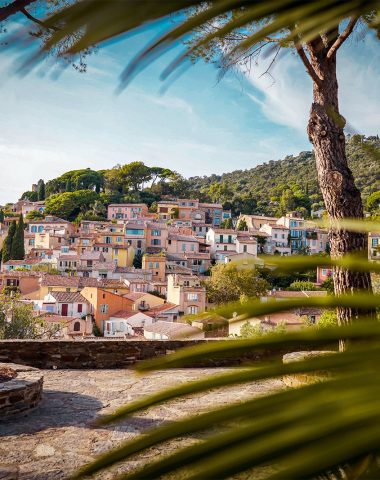












Perched on a narrow promontory overlooking the village of Bormes les Mimosas, the plain and the sea, the castle of the Lords of Fos occupies an exceptional strategic position.
Eight centuries of history overlooking Bormes-les-Mimosas
Located at an altitude of approximately 180 meters, this site once allowed for the surveillance of the territory while its commanding position asserted the power and prestige of its occupants. Even today, its jagged outline and partially ruined walls constitute one of the most picturesque features of the Bormes landscape.
But behind these ruins lies a story of almost eight centuries: that of seigneurial power , the Wars of Religion , the arrival of the Minims religious order , the French Revolution and, finally, the birth of a heritage to be preserved.

The castle of the Lords of Fos, center of seigneurial power
The history of the castle is closely linked to that of the seigneury of Bormes. From 1257, Roger de Fos established himself on this promontory overlooking the village. The site then became the center of seigneurial power.

The choice of this location was no accident. From this vantage point, the lords could survey a large part of their territory, control the routes, and visibly assert their power. The castle overlooked the houses, the cultivated land, and the plain stretching to the sea: it was also a defensive stronghold surrounded by ramparts. The construction and transformations of the building continued throughout the Middle Ages.
The lordship was not limited to the castle. It also included the village , the woods, and the arable land. This land was organized according to the manorial system: a portion, called the demesne, was exploited for the benefit of the lord, while the holdings were granted to peasants in exchange for dues and obligations.
1589: The tragedy of the Wars of Religion
At the end of the 16th century, the Wars of Religion plunged Provence into a period of deep divisions.
On the night of February 15, 1589, the Château de Bormes became the scene of a particularly violent episode. Amidst political and military rivalries, soldiers opposed to the lord of Bormes, Pompée de Grasse, seized the castle with the support of local inhabitants. Pompée de Grasse and his brother were killed during the attack.
Accounts tell of his wife and daughters managing to escape and flee the castle. This dramatic story testifies to the violence of the conflicts that then plagued Provence and left a lasting mark on the site's history.
1654: From the lord's castle to the Minims convent
A century later, the castle underwent a decisive transformation.
In 1654, the lord of Covet left the old fortress to settle in a residence located outside the ramparts. The castle was then ceded to the Minims, a religious order founded in the tradition of Saint Francis of Paola. The former lord's residence became a convent. This new function profoundly transformed the site. After having been for centuries the symbol of feudal power, the castle entered a religious period that continued until the French Revolution. For nearly a century and a half, the inhabitants of Bormes-les-Mimosas thus adopted the custom of referring to the old castle by another name: the Convent.
The Revolution and the beginning of the decline
At the end of the 18th century, the French Revolution drastically altered the history of the monument.
The convent , still largely preserved at the time, was affected by the disappearance of religious communities. At the beginning of the revolutionary period, the building served notably as barracks for volunteers joining the armies of the Republic.

This use marks the beginning of a period of profound transformation and deterioration. The building is subsequently sold and passes through the hands of various private owners.
Gradually, the old castle-convent lost its original function. Maintenance became more difficult and the building progressively deteriorated. Its walls were partially demolished, its roofs disappeared, and the monument gradually took on the ruined appearance we know today.
From ruin to heritage
During the 19th and early 20th centuries, several owners succeeded one another.
The various successive owners undertook conservation and restoration work.
By the beginning of the 20th century, the castle was already largely in ruins. Yet it is precisely this aspect that contributes to its character. Successive interventions have sought to preserve the monument while maintaining its extraordinary exterior silhouette, which has become inseparable from the landscape of Bormes.
The site gradually gained official recognition. In 1926, it was protected as a protected site. In 1931, the remains of the castle were listed as historical monuments.
Even today, the castle remains privately owned . Its ruins nevertheless continue to dominate the village and recall the major stages of Bormes' history.


The former Saint-Trophyme chapel
Within the castle walls was also an old chapel dedicated to Saint-Trophyme.
This small church served for several centuries as the main parish church of Bormes. Perched on the rock, it was traditionally oriented towards the east, in the direction of the rising sun. This orientation, common in Christian architecture, symbolically links the morning light to the resurrection of Christ.
Used for several centuries, the chapel gradually became too small and too dilapidated to meet the needs of the population. At the end of the 18th century, it was abandoned and replaced by a new parish church built in the heart of the village: the Church of Saint-Trophyme , located on Rue Carnot.
The apse of the old castle chapel remains in particular, a precious testimony to the first parish of Bormes and to the religious importance that the promontory long held.
The castle of the Lords of Fos, facing the sea
From the castle, the view opens onto a vast territory.
Below lies the plain, once largely devoted to agriculture. The land produced cereals, legumes, and other crops adapted to the Mediterranean climate. La Favière , by its name, still recalls the former importance of broad bean cultivation in this part of the region.
This view allows us to understand the full strategic importance of the castle of the Lords of Fos. From its promontory, the lords dominated the lands that ensured part of their wealth and could monitor access to the village.

Today the silhouette of the castle continues to watch over Bormes les Mimosas, at the crossroads between the Mediterranean and the Massif des Maures!
Discover the heritage of Bormes les Mimosas
The castle of the Lords of Fos is just one of the many witnesses to the history of Bormes-les-Mimosas . From the medieval village to religious buildings, including fountains, chapels, and ancient ramparts, Bormes' heritage unfolds along its streets and paths. Continue your exploration of Bormes-les-Mimosas' heritage and discover the places that tell the story, traditions, and identity of the town.


