










The Chemin des Sages project was born during a meeting of the Council of Elders, composed of 9 women and 9 men aged 60 and over, chosen for their wise experience by the municipal councilors. On that day, the topic of discussion was how to bring our republican motto, "Liberty, Equality, Fraternity," to life.
The birth of the Path of the Sages
The idea arose that scattering quotes from illustrious men and women , renowned worldwide for their wisdom and humanism , throughout the town could resonate with both locals and tourists. To justify this bold and innovative project to the Mayor and the Town Council, the decision was made to link this route to the historical plaques that were to be installed on the town's iconic monuments. The members of the Council of Elders then determined the path through the medieval village and worked on the materials, texts, images, and symbols for these plaques.

The butterfly symbol was chosen because it represents joy, beauty, grace, and the lightness of being. It evokes the power of personal transformation through its strong capacity for rebirth. Indeed, before becoming a butterfly, this insect is first an egg, then a caterpillar, then a chrysalis, and finally a butterfly. Each new stage symbolizes a change in life, letting go of who you were to appreciate who you have become. As a symbol of wisdom, this animal is a source of inspiration in life. Beneath its fragile appearance,
The butterfly possesses great strength. Indeed, its life is ephemeral (lasting from a few days to a few weeks), and yet it spreads joy and good cheer through the grace and beauty of its flight, appreciating every moment that nature offers. So why not be like the butterfly, approaching with confidence everything that life offers us , good or bad experiences, because after all, it only lasts a moment? Aren't these past experiences the best preparation for the future , allowing us to move forward with greater serenity on life's path?
Voltaire's biography
Philosopher of the Enlightenment, committed to the service of freedom, worldly poet, "imprisoned" writer, exiled, courtier, "lord" and "patriarch" in his old age.
Voltaire was born in Paris on November 21, 1694, and died in the same city on May 30, 1778. Thirteen years later, in 1791, his remains were solemnly transferred to the Panthéon. His father was a notary, and his mother died when he was seven. From the age of seventeen , Voltaire aspired to be a man of letters . He was sent to the Jesuit college Louis-le-Grand (formerly the Collège de Clermont), and later studied at the Faculty of Law in Paris. This did not prevent him from indulging in libertine pursuits and wit.

From 1715 onwards, he frequented libertine circles and literary salons, composing satirical writings that led to his imprisonment in the Bastille. In prison, he wrote Oedipus (1717). He traveled in Europe and became involved in court intrigues. He continued to write for the theater. An altercation with the Chevalier de Rohan-Chabot earned him twelve days in the Bastille, followed by exile in England (1726). His satirical writings against the Regent led to his exile to the provinces and then imprisonment in the Bastille; Voltaire loved controversy. Key themes emerge from his work: he advocated the existence of God, but
He criticized revealed religions , believing that only morality mattered. He abhorred fanaticism and valued democracy, but considered it applicable only to small states. He also rejected the idea of inherent goodness in humankind, thus opposing Rousseau. His literary output was varied, ranging from plays and philosophical tales to more historical and polemical texts. His Philosophical Letters (1734) and Philosophical Dictionary (1764) are particularly noteworthy . Voltaire continued his fight for tolerance with his treatise on tolerance.
He returned to France in 1728 and was appointed royal historiographer in 1745 , but he did not abandon the tale (Zadig). A "lord" and "patriarch" of Ferney in his later years, Voltaire returned to Paris to die, basking in his glory. Voltaire, one of the most important philosophers of the Enlightenment , led an eventful life, marked by his commitment to the cause of liberty. A tireless and prolific worker, he left behind a considerable and highly varied body of work that touched on all fields, revitalized the historical genre, and elevated the tale to an art form.
The museum and its past lives
The building is one of the oldest residences in the city, built in the mid-17th century on Rue des Fours, the first street outside the castle walls. The street was renamed Grande Rue and then Rue Carnot in 1894 in honor of the president of the same name.
The building has served various purposes over time. It was used as a municipal school from 1660, housing a small school for boys. Later, female teachers instructed young girls in Christian virtue at another location in the village. It also served as the town hall, hosting council meetings, elections, and public debates , and was even used as a jail and court for minor offenses. In 1788, due to the building's dilapidated state and the increasing number of students, the municipality considered constructing a new town hall and school building.

In 1892, this new town hall and school was built on Place Saint-François to separate the courthouse and prison from the school. The old building had been abandoned and nearly demolished, but it was ultimately saved. In 1934, Lucien Metzger, a Parisian antique dealer, acquired part of the building and, with his wife, undertook restoration and expansion work . They connected the two buildings, added a floor, created a large living room, and restored the ceilings.
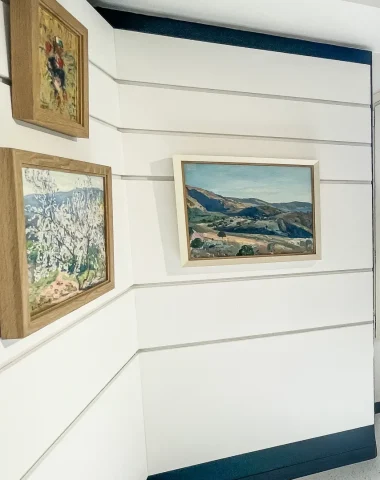
In 1978, the municipality purchased the building and transformed it into a museum, named the Charles Cazin Museum. Renovation and refurbishment work was undertaken, and the building was opened to the public. Since then, it has housed exhibitions and various cultural activities. Restoration work was carried out in 1982, including the renovation of the façade in 1983. Thus, the building has witnessed different eras , contributing to the history and culture of the town of Bormes-les-Mimosas.

Also find the Path of the Sages on Baludik!
To discover the fun and geolocated route, scan this QR code. Games and surprises await you with the Baludik application.