











The Chemin des Sages project was born during a meeting of the Council of Elders, composed of 9 women and 9 men aged 60 and over, chosen for their wise experience by the municipal councilors. On that day, the topic of discussion was how to bring our republican motto, "Liberty, Equality, Fraternity," to life.
The birth of the Path of the Sages
The idea arose that scattering quotes from illustrious men and women , renowned worldwide for their wisdom and humanism , throughout the town could resonate with both locals and tourists. To justify this bold and innovative project to the Mayor and the Town Council, the decision was made to link this route to the historical plaques that were to be installed on the town's iconic monuments. The members of the Council of Elders then determined the path through the medieval village and worked on the materials, texts, images, and symbols for these plaques.

The butterfly symbol was chosen because it represents joy, beauty, grace, and the lightness of being. It evokes the power of personal transformation through its strong capacity for rebirth. Indeed, before becoming a butterfly, this insect is first an egg, then a caterpillar, then a chrysalis, and finally a butterfly. Each new stage symbolizes a change in life, letting go of who you were to appreciate who you have become. As a symbol of wisdom, this animal is a source of inspiration in life. Beneath its fragile appearance,
The butterfly possesses great strength. Indeed, its life is ephemeral (lasting from a few days to a few weeks), and yet it spreads joy and good cheer through the grace and beauty of its flight, appreciating every moment that nature offers. So why not be like the butterfly, approaching with confidence everything that life offers us , good or bad experiences, because after all, it only lasts a moment? Aren't these past experiences the best preparation for the future , allowing us to move forward with greater serenity on life's path?
Simone Veil's biography
Survivor of deportation, icon of the fight for women's rights, Minister of Health, Minister of State, President of the European Parliament, immortal at the Académie Française.
Simone Jacob , born on July 1, 1927, in Nice to a Jewish family , was the youngest of four children. On March 1, 1944 , the day after her baccalaureate exams, she was arrested by the Gestapo and deported to Auschwitz with her mother and older sister, Madeleine. That same night, the prisoner number 78651 was tattooed on her arm (a number she would later have engraved on her academician's sword in 2010). She lost her mother, father, and brother in the Holocaust camps.
Back in Paris in May 1945, she learned that she had been passed the baccalaureate exams and registers for the Faculty of Law and the new Institute of Political Studies. This is where she meets Antoine Veil, with whom she getting married October 16, 1946 and they will have 3 wires. From 1957 to 1964, she was permanent attaché at the Prison Administration Directorate where she will fight for theimprovement of the fate of prisoners. She is then assigned to the Civil Affairs Directorate, she writes the adoption bill. In 1969 she became technical advisor in the office of René Pleven, Minister of Justice. In 1970, she was appointed Secretary General of the High Council of the Judiciary (CSM) by President Pompidou (first woman to hold this position). De 1974 to 1979, Simone Veil is appointed Minister of Health following the election of Valéry Giscard
d'Estaing became President of the Republic, where she was the only female minister in that government. On January 17, 1975 , the Veil Law, authorizing voluntary termination of pregnancy, was promulgated. Its 40-minute text, following a heated debate in the National Assembly, would shake French society and secure its place in history. The law was passed provisionally for a period of five years and was renewed in 1979. She was elected President of the European Parliament on July 17, 1979, a position she held until January 1982. She continued her involvement in European politics, heading the Parliament's legal service until 1993. In 1993, she became the first woman Minister of State, serving as Minister of Health and Social Affairs in Édouard Balladur's government.

In 1997, she was elected president of the High Council for Integration under the government of Alain Juppé, where she worked on issues of equal opportunity. From 1998 to 2007, she completed her career at the Constitutional Council. From 2000 to 2007, she also served as president of the Foundation for the Memory of the Shoah. In 2008, she was elected to the French Academy, occupying seat number 13 (previously held by Paul Claudel, Pierre Loti, Pierre Messmer, and Jean Racine). In 2012, François Hollande, President of the Republic, awarded her the insignia of Grand Cross of the Legion of Honour. Following the deaths of her husband and sister in 2013, Simone Veil withdrew from public life and died at her Parisian home on Place Vauban on June 30, 2017, a few days before her 90th birthday . July 1, 2018, marked Simone Veil's entry into the Panthéon . On March 8, 2019, Emmanuel Macron presented the first "Simone Veil Prize of the French Republic" to reward "actions around the world in support of women's rights," with a prize of 100,000 euros.
The remains of the ramparts
From the 5th century BC onwards , the settlement of Celtic and Ligurian tribes in Provence fostered the development of trade and prosperity in the region. However, this wealth also attracted the covetousness of pirates and corsairs from the coasts of Turkey and North Africa. Maritime attacks were frequent, aimed at seizing goods and ships and capturing crews to sell into slavery. Hundreds of thousands of Provençals, Italians, and Spaniards were thus abducted and sold over the centuries. Due to these risks, coastal villages were abandoned and relocated to higher ground , offering better surveillance of sea inlets, an assessment of potential dangers, and preparation for defense. Some communities built defensive walls surrounding their inhabited areas to protect themselves from invasions.

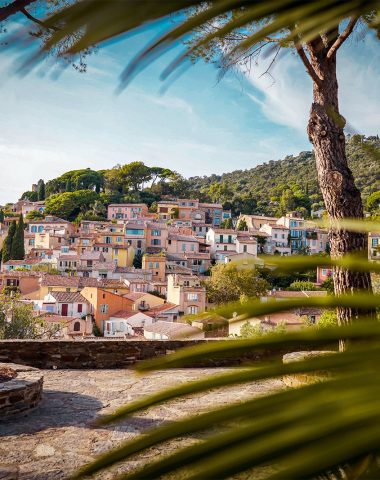
In Bormes , the first inhabitants settled on higher ground around the 9th century and had to organize their own defenses against Saracen raids. Although the Counts of Provence drove the Saracens from the Maures hills, they still posed a threat to merchant ships. Between 1167 and 1196 , a protective wall was built in Bormes, measuring 6 to 8 meters high and 1,30 meters thick. It was composed mainly of local stone quarried from schist. Limited openings were incorporated to avoid compromising the defenses. The gates were strategically placed at the village's historical access points and were often guarded during times of invasion or epidemic. Some remains of this wall still survive in the village, primarily on the northern edge of Rue Carnot. A section of wall in front of the Saint-Trophyme church bears witness to the old entrance gate, with stones dating from the 12th century, recalling a troubled period of invasions when the population found refuge behind these fortifications.

Also find the Path of the Sages on Baludik!
To discover the fun and geolocated route, scan this QR code. Games and surprises await you with the Baludik application.