










The Chemin des Sages project was born during a meeting of the Council of Elders, composed of 9 women and 9 men aged 60 and over, chosen for their wise experience by the municipal councilors. On that day, the topic of discussion was how to bring our republican motto, "Liberty, Equality, Fraternity," to life.
The birth of the Path of the Sages
The idea arose that scattering quotes from illustrious men and women , renowned worldwide for their wisdom and humanism , throughout the town could resonate with both locals and tourists. To justify this bold and innovative project to the Mayor and the Town Council, the decision was made to link this route to the historical plaques that were to be installed on the town's iconic monuments. The members of the Council of Elders then determined the path through the medieval village and worked on the materials, texts, images, and symbols for these plaques.

The butterfly symbol was chosen because it represents joy, beauty, grace, and the lightness of being. It evokes the power of personal transformation through its strong capacity for rebirth. Indeed, before becoming a butterfly, this insect is first an egg, then a caterpillar, then a chrysalis, and finally a butterfly. Each new stage symbolizes a change in life, letting go of who you were to appreciate who you have become. As a symbol of wisdom, this animal is a source of inspiration in life. Beneath its fragile appearance,
The butterfly possesses great strength. Indeed, its life is ephemeral (lasting from a few days to a few weeks), and yet it spreads joy and good cheer through the grace and beauty of its flight, appreciating every moment that nature offers. So why not be like the butterfly, approaching with confidence everything that life offers us , good or bad experiences, because after all, it only lasts a moment? Aren't these past experiences the best preparation for the future , allowing us to move forward with greater serenity on life's path?
The biography of Alexandra David-Néel
Explorer, musician, icon of female emancipation, Franco-Belgian journalist and writer.
Louise Eugénie Alexandrine Marie David, known as Alexandra David-Néel, was born in France on October 24, 1868, the only child of a Belgian Catholic mother and a French Protestant father who was a Freemason. She converted to Buddhism at the age of 21. Passionate about the Orient, she studied Sanskrit and Tibetan and pursued various religious studies. She entered the Royal Conservatory of Brussels to study singing and piano. An opera singer, she became the leading singer at the Hanoi Opera House before meeting her future husband, Philippe Néel, chief engineer of the Tunisian railways, in Tunis. They married in 1904.

In 1911, she embarked alone on a journey to India and Tibet, promising her husband she would return in 18 months. She would not return until 14 years later. Nevertheless, the couple remained connected through a rich written correspondence, a testament to their mutual affection. During her trek in the Himalayas, she met Aphur Yongden, who would become her adopted son. In 1912, she was granted an audience with the 13th Dalai Lama, and subsequently traveled through Tibet, China, and Japan, corresponding with numerous religious figures. From 1923 to 1924, disguised as a beggar, with her adopted son Aphur Yongden disguised as a monk, they traveled over 2000 kilometers and entered Lhasa, the capital of Tibet, which was forbidden to foreigners. They spent two months there before being discovered. Upon their return to France, Alexandra discovered the notoriety her adventure had brought her and published her account. She wrote several articles for the feminist newspaper La Fronde, founded by journalist and actress Marguerite Durand, and participated in meetings of the National Council of French Women. Alexandra David-Néel fought for the economic emancipation of women, which distanced her from feminists who were mostly from the bourgeoisie.
The long period of her life preceding her rise to fame in the world of literature and Orientalism constitutes both the source and the defining foundation of such an extraordinary journey for a woman of her time. Enriched by a vast array of encounters and experiences, her life was built around social and political commitments. On the one hand, through her feminist and anarchist stances, and on the other, through her philosophical involvement with Freemasonry. Finally, she also enjoyed a fulfilling artistic life, notably in opera. Alexandra David-Néel died on September 8, 1969, at the age of 100. Her ashes and those of her adopted son were scattered in the Ganges . The name of Alexandra David-Néel is inextricably linked to the exploration of Tibet.
Lou Portaou and the alleys of the Middle Ages
"Lou Portaou," in Provençal , refers to the main entrance to the village. In the past, it was the only gate allowing passage for carts. Located higher than Rue Carnot, access was , as it is today, via a ramp . During periods of lordship, particularly during epidemics such as the plague, this place was guarded. This important passage could also serve as a toll point for various taxes. It had to be high and wide enough to allow the passage of a loaded cart or a man on horseback. Upon entering, every visitor was under the protection of the ramparts and the armed men of the lordship. The wall, 6 to 8 meters high and 1,30 meters wide, surrounded the original village.
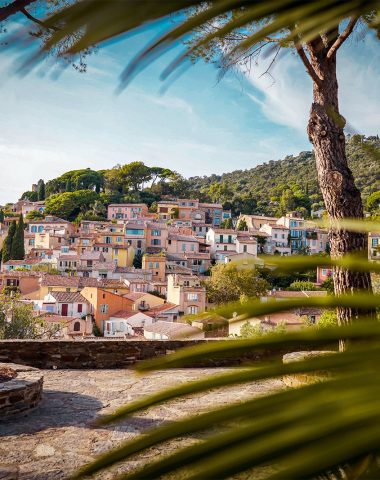
From this entrance , visitors could disperse throughout the village , laid out around narrow alleyways built to follow the winding terrain and using the rocks as anchor points. The main objective was simple: to break the course of the prevailing wind. The mistral, this cold wind from the northwest, could be very destructive and blow for several days. The narrowness of the alleyways could also pose an obstacle to an invader, limiting the passage of large numbers of soldiers and thus hindering an attack.


The ground was generally packed earth, except for busy alleyways or steep slopes. In these cases, the villagers created a "calade," a paved surface of local stones laid on their edges to protect the ground from damage caused by frequent foot traffic and erosion. Although runoff was channeled, the streets also served as a dumping ground. On very steep streets, they became slippery, as evidenced by the name of Rompi cuou Street , where it was easy to slip and hurt oneself … on the backside!

Also find the Path of the Sages on Baludik!
To discover the fun and geolocated route, scan this QR code. Games and surprises await you with the Baludik application.